
Where every Knife is a work of art
Arts from Navajo Land, USA

Your Source for Top-Quality Custom Knives and Jewelry
For decades, David Yellowhorse has been crafting custom knives and exquisite jewelry, blending traditional Native American artistry with high-quality craftmanship. He has gained worldwide recognition for his artistic knives, which showcase his signature stone inlays and intricate design. Each piece is a testament to his deep-rooted heritage and meticulous attention to detail.
SHOP NOW

Buck 55 Yellowhorse – Eagle Feather
Original price was: $230.00.$189.00Current price is: $189.00.
Kershaw “Old Glory” by Yellowhorse
Original price was: $220.00.$179.00Current price is: $179.00.
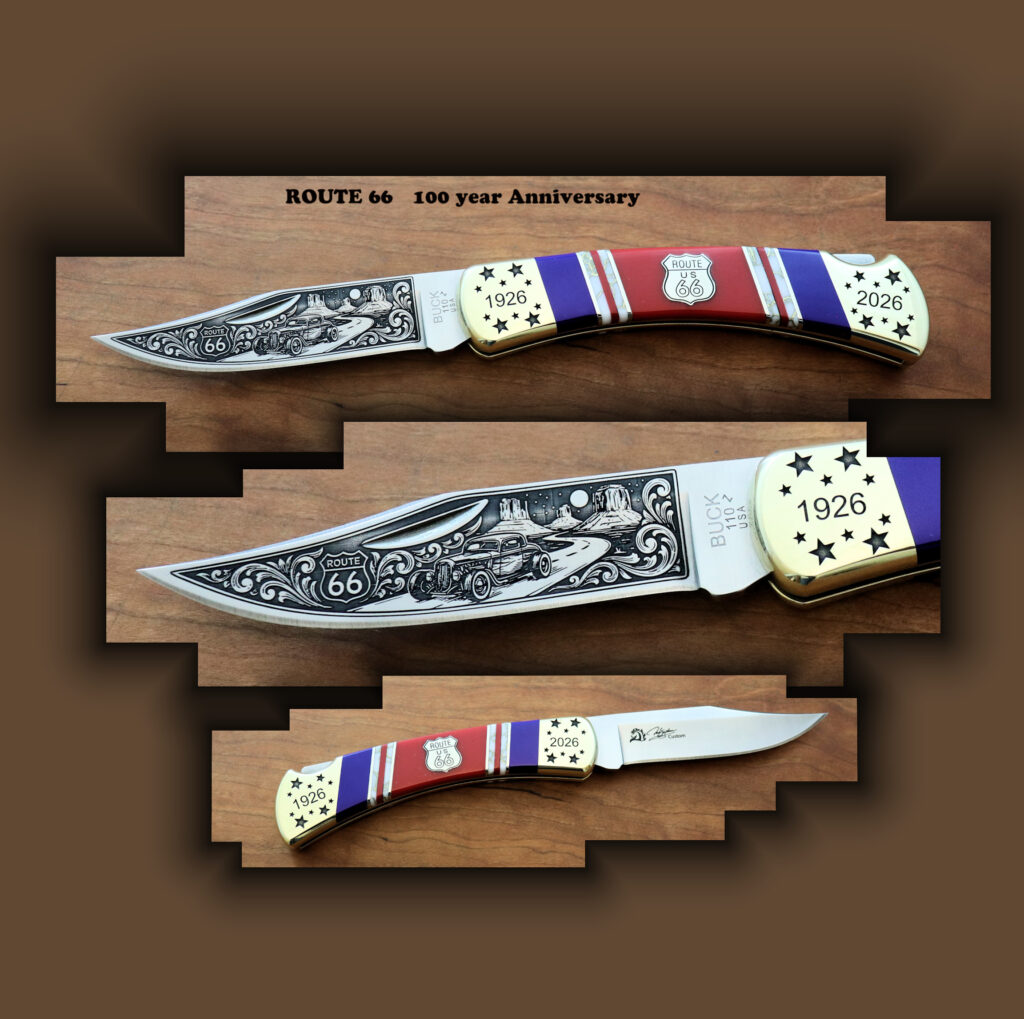
Buck 110 Route 66 – 100 years
Original price was: $499.00.$325.00Current price is: $325.00.
Buck 110 Cuthair II – The Silversmith
Original price was: $420.00.$298.00Current price is: $298.00.
Kershaw Deer Hunter by Yellowhorse
Original price was: $215.00.$169.00Current price is: $169.00.
Buck 112 Yellowhorse, 250th Anniversary America
Original price was: $410.00.$289.00Current price is: $289.00.
Buck 55 Yellowhorse, 250th Anniversary America
Original price was: $230.00.$189.00Current price is: $189.00.
Coffee Mug – Yellowhorse
Original price was: $34.00.$24.00Current price is: $24.00.
Kershaw Sacred Eagle by Yellowhorse
Original price was: $215.00.$169.00Current price is: $169.00.
Buck 110 “We the People”
Original price was: $220.00.$185.00Current price is: $185.00.




The Original Stone Inlay Knife Handles Since 1978
David Yellowhorse revolutionized the knife-making industry by introducing stone inlays to customer knife handles in 1978. His innovative approach transformed functional tools into remarkable work of art. Every custom knife he creates tells a story, celebrating both Native American culture and the artistry of fine craftmanship. His designs have become highly sought after by collectors and knife enthusiasts alike.
Featured Article
Knife Magazine
David Yellowhorse: Knives with Heritage
By Stephen Garger
KnifeMagazine.com
October 2019

In late July 2018, after a short drive to the Buck Factory in Post Falls, Idaho, I joined members of the Buck Collectors Club for a series of events celebrating their 30th Anniversary (1988-2018). One of the scheduled sessions featured David Yellowhorse, a celebrated knife embellishment artist. The room was filled for his presentation, and during one of David’s stories, the word “equanimity” occurred to me. I was taken with his calmness, composure, and even temperament [‘equanimity’].
Those admirable traits were apparent in David’s effect and reinforced by a story about the flight of a drone around his Arizona home. I was curious to learn more about this man. That evening, while disembarking following the Club’s Lake Coeur D’Alene dinner cruise, I introduced myself and promised to be in touch. Some time later, we spoke on the phone.
David’s interest in silversmithing, sand casting, and entrepreneurial spirit derives from a family tradition going back to Frank Yellowhorse, his 86-year-old father, and the tradition lives on through David’s son Brian.
During the 1950s, Frank sold Navajo rugs and petrified wood at a stand along Route 66. Over the next decade, the Navajo family’s stand expanded into a trading post, located today on the Navajo Reservation just off Interstate 40 at the border of Arizona and New Mexico. It was here that young David began meeting and interacting with tourists making their way through Arizona.
Growing up, he would see his father and Uncle Shush doing silver work but “didn’t stop and really look since I wasn’t interested in what grown-ups were doing.”
Eventually, David asked questions and started helping out, especially curious about the silversmithing and sand casting. “I kept learning and did a few things, nothing too magical or anything,” he related. “But it did strike my interest and I did like it quite a bit.” Helping enabled the youngster to begin figuring some aspects of the craft out for himself, and to “learn more about things.”
At that time, his parents were separated, and his mother and brothers lived in Al Albuquerque. David moved there for school, was faring well, and one day, his dad paid a visit and asked: “What do you want to do in life?” David thought for a while before responding about how much he enjoyed silversmithing and the time with his father and uncle. The following year, his dad returned and, this time, left two black cases of jewelry, saying: “This is your start. I want you to see Indian jewelry.”
David inventoried the contents of the bags. “There were Navajo, Zuni, and Hopi pieces in there, priced on the back for retail,” he recalled. “By the time I got it all calculated, there was $20,000 worth of jewelry, and I wondered, ‘Where am I going to sell this stuff?”
The narrative continued: “I went to Old Town in Albuquerque on weekends (I was in high school) and set up there. Somebody told me the real good place to be is Santa Fe, NM, so I went the next weekend and parked where lots of natives were set up in the square. I got my jewelry and my blanket and started making myself a little spread. People were grumpy because I was intruding on their area. These were Pueblos, Santa Domingos, Santa Claras—I wasn’t familiar with… any of them.”
It did not go smoothly for young Yellowhorse: “A woman with the biggest spread, Carnation, was the head of everybody, and for the first three weekends, she’d approach my blanket, grab one end, and flip it to scatter my jewelry, telling me ‘We don’t want you here!” She was elderly, and out of respect, you just can’t yell or scream; plus, I was a kinda stubborn little kid.”
David would quietly put his spread back together and just carry on, adding that other Navajos were treated the same, “but after a rug pull, they were gone.”
As it happened, one day, he chased down a thief and recovered a squash blossom necklace of Carnation’s. “I brought it back, from me, says nothing, but from that point held it out to her, and she grabbed the necklace and never came over and flipped my rug.” David noted that although she would talk to him, “the other Santa Claras would, and I was in!”
He began making small earrings and their pieces, continuing to sell them there. “It was credited but never made it through,” David said in my last year of high school; I had enough said. “There was this big Mexican Fiesta happening, so I ‘ditched’ [school] for a week to go sell, made $2800, and never went back to school.”
David was doing well in 1973 when his dad moved to the Glendale suburb of Phoenix and asked him to come help and be the head of his shop. “My dad means the world to me, so there was no way I could turn him down,” David explained. “He had a nice shop there, doing nice handmade silver link chains.” But David “found the work repetitious, got bored, and started doing channel inlays like the Zunis (who always impressed me).”
He self-learned channel inlay and started developing a small line that people liked. When his father decided to return home, David moved into the house and took over the shop. “I was responsible for a $255 a month mortgage and a 24-acre lot in Glendale and had to get pretty serious,” he recollected. “My brother graduated without any plan, and I told him I’ll put you to work until you find something,’ he liked what I was doing and stayed 15 years.”
When his brother-in-law got out of the Air Force, David gave him a job, and it turned out he also liked the work. “I stopped being a one-man band—I had employees,” David said, laughing. “I had three different designs with channel inlays that went well and I taught them the inlay and how to do it.
Every Friday was when David would go out and sell. “I sold to five different shops at Scottsdale, Payson, Camp Verde, Flagstaff, Sedona, and back to Phoenix.”
The work David grew to be best known for was hit upon serendipitously: “In 1978, we’d sit under a tree for lunch and got to throwing our knives at it. Eventually, this Buck 112 knife took too many slams sideways, and the handle cracked on one side.
That night, I was up until 2 am working on a lady’s cuff bracelet for her to pick up at 8:30 in the morning, so I was pretty wound up with coffee. I remembered my knife needed repair, and I mixed some epoxy and put up the heat lamp but forgot about it, and the epoxy solidified. So I tried a creative venture: I pried the handle off and started putting some of my scrap stone pieces in there. By early morning, I had one side inlaid and liked it.”
On that Friday’s sales rounds, David showed his clients the knife. They asked why he didn’t do the other side while encouraging him to bring more in. David bought six knives at L.L. Smith Hardware, pried the handles off, inlaid on both sides and on Friday, each customer bought one. They were sold out by Monday.
“Everyone sold the knives that weekend, and that’s how my knives got started back in 1978,” he explained. “L.L. Smith Hardware and Bob’s Sporting Goods kept me supplied decently, and those knives kept selling well with just one model [Buck 112].” David saved up enough money to get a brochure together and sent it to other dealers, though “there wasn’t much response.”
In 1984, he began doing smaller pocket knives. I found an importer and bought six Explorer models (made in Japan) from Gutmann Cutlery. The people liked them, and all of a sudden, I was doing a lot of the small knives,” he said. “I was buying German Pumas too, so now I was inlaying Bucks, Pumas and Explorers.”
After an article featuring Gutmann Cutlery was published, they heard from a company wanting to include David’s knives in their catalog. That company was The Sharper Image, and founder/CEO Richard Thalheimer offered to buy 700 of his knives, but David had a problem when he read the vendor agreement package they sent. He phoned and told the person who sent it: “I cannot do what the agreement calls for.”
She replied that there was a lot of money involved, but David characteristically responded: “There’s not enough money in the world to make you mad at me.”
He received a call from the supervisor the next day after she spoke with Thalheimer, who said to her, ‘You tell Mr. Yellowhorse whatever he wants, he has. I want him in this catalog!” David paused for a moment before concluding, “That was my first and only knife in a national catalog, and all of a sudden, I was exposed to high-end money.”
The Buck Knives company’s well-known affiliation with David Yellowhorse also got off in David’s typically personal fashion.
Explore our selction of custom knives, jewelry, and more.